


Press Releases
September 9, 2026
DOCOMO Conducts Green Base Station Demonstration with PLDT in the Philippines to Advance Decarbonization Technologies
— Weather-Forecast-Linked Lithium-Ion Battery Control Technology of DOCOMO Deployed Overseas for the First Time —

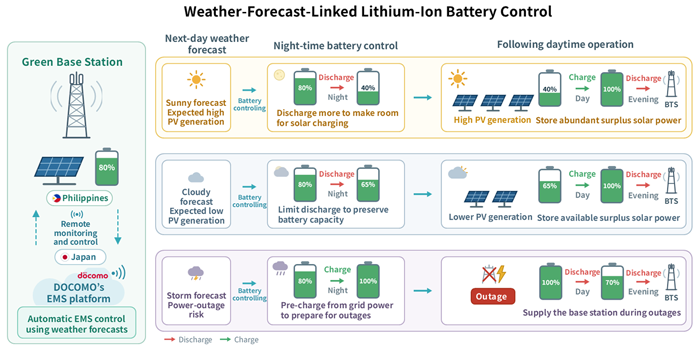
TOKYO, JAPAN, September 9, 2026 --- NTT DOCOMO, INC., together with the Philippine telecommunications operator PLDT Inc. and its mobile subsidiary Smart Communications, Inc., has successfully conducted a demonstration in the Philippines using renewable energy such as solar power*1 and DOCOMO's weather-forecast-linked lithium-ion battery control technology.*2 The technology automatically optimizes, based on the weather forecasts, the charging and discharging of batteries used at green base stations. The demonstration results showed that solar power utilization efficiency improved by 23 percentage points, from 38% before the demonstration to 61%. DOCOMO independently developed the technology for green base stations in Japan, and this demonstration marks the first deployment of this technology outside Japan.
For the demonstration, two green base stations were built—one near Metro Manila and one at a site in Cebu with different operating and power-supply conditions. In addition to solar power equipment and battery storage systems, the stations use DOCOMO's Energy Management System (EMS) platform,*3 an energy management system incorporating weather-forecast-linked lithium-ion battery control technology. According to PLDT, this is the first initiative in the Philippines to optimize power generation, storage and supply at telecommunications base stations in advance based on weather and electricity demand forecasts.*4
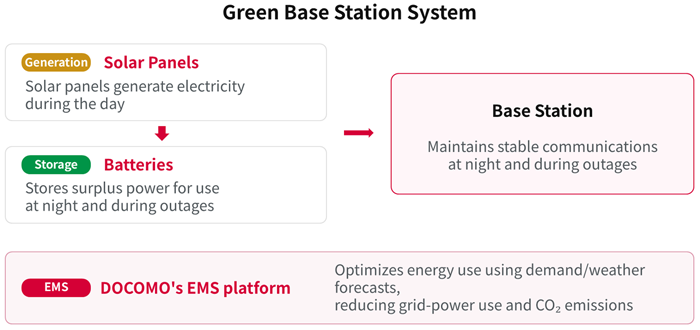
Conventional solar-only base stations rely on grid power at night and during bad weather and risk of service interruptions during power outages. The demonstration incorporates high-capacity batteries and a locally redesigned version of weather-forecast-linked lithium-ion battery control algorithm developed by DOCOMO.*5 The system optimizes power generation, storage and supply around the clock, maintaining stable service at night and during outages while improving renewable-energy use, reducing grid-power consumption and CO₂ emissions, and decarbonizing base stations.
As a shareholder of PLDT, DOCOMO has built a strong, long-standing relationship with the company through capital ties and technical cooperation. This demonstration is part of that collaboration and addresses the shared management priority of decarbonizing communications infrastructure through a long-term, stable partnership. DOCOMO will continue working with PLDT to build sustainable communications infrastructure in the Philippines and surrounding regions while promoting sustainable growth and creating new value.
DOCOMO's EMS platform used in this demonstration will be exhibited at Smart Energy Week, which opens at Makuhari Messe on Wednesday, September 9, 2026.
- Repeatedly available energy sources such as sunlight and wind that do not emit greenhouse gases when generating power.
- DOCOMO developed its weather-forecast-linked lithium-ion battery control technology in 2016. Based on weather forecasts, it automatically and flexibly adjusts the share of lithium-ion battery capacity reserved for communications backup during outages and the share used for routine solar charging and discharging, minimizing charge-discharge losses.
- An energy management system that monitors electricity use and optimally controls power generation, storage and supply.
- Source: PLDT, as of August 2026.
- A paper on the control algorithm adapted to local climate and power conditions received the Second Best Paper Award at icSmartGrid2026, an IEEE-co-sponsored international conference held in Romania in July 2026.
Appendix
Overview of the Demonstration
- 1. Background
DOCOMO has deployed 329 green base stations in Japan as of March 31, 2026, building expertise in renewable-energy utilization and energy-control technologies, while leading the research and development for Distributed Energy Resources (DER) and Energy Management Systems (EMS) globally. To expand these technologies internationally, DOCOMO has worked with PLDT and Smart to verify their applicability in the Philippines. DOCOMO is a shareholder of PLDT, and this initiative builds on long-standing capital alliance and technical cooperation between these 2 companies. - 2. Details of the Demonstration
- Implementation and Objectives
Demonstration stations were built at two locations—near Metro Manila and at an off-grid site in Cebu with different power-supply conditions. Each green base station combines solar power equipment, a battery storage system and DOCOMO's EMS platform.
Weather-forecast-linked lithium-ion battery control technology of DOCOMO was used, with the control algorithm redesigned to suit local climate and power conditions in the Philippines. Power generation, storage and supply are controlled and optimized in conjunction with weather forecasts.
The objective is to verify reductions in grid-power use and CO₂ emissions by improving the efficiency of renewable-energy use while maintaining stable communications at night and during power outages. - Green Base Station Installation Environments
Green base stations were built at the following two locations. Testing under different environmental conditions verifies the technology's effectiveness near Manila and at the specific demonstration site on Cebu Island.Site Environment Metro Manila On-grid station (grid power available) Cebu Off-grid station (no grid power) - Equipment Installed at the Demonstration Green Base Stations
The following equipment was installed at the green base stations built for the demonstration.
Equipment Description Solar Power Equipment Generates electricity during the day and supplies renewable energy. Battery Storage System Stores surplus daytime power and supplies it reliably at night and during outages. DOCOMO's EMS platform Controls and optimizes power generation, storage and supply according to electricity demand and weather information.
- 3. Roles of Each Company
DOCOMO Provision of green base station and energy-management technologies
Overall planning, management of the demonstration and effectiveness verificationPLDT / Smart Provision of base station equipment, installation sites and local power data
Support for applications to government and local authorities
Local cooperation, etc. - 4. Demonstration Results and Benefits
- Benefits of DOCOMO's Technology
DOCOMO's weather-forecast-linked lithium-ion battery control technology improved solar power utilization efficiency by 23 percentage points. The battery systems also enabled the effective use of 3,905 kWh of surplus solar power that had previously gone unused.Solar power utilization efficiency with DOCOMO's technology
+23 percentage points
38% → 61%Previously unused surplus solar power utilized through battery storage
3,905 kWh - Contribution to Sustainability
Field validation conducted from April 2026 achieved electricity savings of 600 kWh year on year and 1,000 kWh month on month. Over the 100 days from April through July 2026, the technology reduced cumulative CO₂ emissions by approximately 2,854 kg. Further reductions are expected through continued efforts and expansion to additional areas. DOCOMO will also seek to use frameworks such as the Joint Crediting Mechanism (JCM)*6 to contribute to greenhouse-gas reductions in the Philippines and Japan.Expected Benefits of the Initiative
Lower Electricity Costs
Reduces grid-power use and base-station operating costs.Lower Greenhouse-Gas Emissions
Reduces CO₂ emissions through renewable-energy use.Stable Communications During Outages
Battery storage keeps communications infrastructure operating during power outages.Effective Use of Renewable Energy
Maximizes the use of solar-generated electricity and improves energy independence.- JCM (Joint Crediting Mechanism) is a framework under which both countries appropriately evaluate contributions to emission reductions achieved by introducing advanced decarbonization technologies and other measures in developing countries.

